Time-tracking obligation at festivals: what applies since the BAG ruling, and how to track 800 crew
Since 2022, employers have had to record the entire working time; for Minijob workers and casual staff, that already applied earlier. What counts as proof, what doesn't, why paper lists fail at a festival, and how QR-code check-in works even without a network.
In short
- Employers must record the start, end, and duration of the daily working time of all employees. This follows from the Federal Labor Court's (Bundesarbeitsgericht, BAG) 2022 ruling on § 3 Abs. 2 Nr. 1 ArbSchG; for Minijob workers and industries covered by the undeclared-work law, § 17 MiLoG requires it explicitly.
- A shift plan is not proof. Proof is the actual time, with start and end, documented by the latest on the seventh day after, retained for two years.
- Paper lists at a festival deliver estimates that don't hold up under a customs inspection or a wage dispute. QR check-in with a timestamp delivers minutes, even offline.
- BAG, Beschluss vom 13.09.2022, 1 ABR 22/21
- § 3 Abs. 2 Nr. 1 ArbSchG
- § 16 Abs. 2 ArbZG
- § 17 Abs. 1 MiLoG
- EuGH, Urteil vom 14.05.2019, C-55/18
Since the Federal Labor Court's (Bundesarbeitsgericht, BAG) ruling of September 13, 2022 (1 ABR 22/21), it's settled: under § 3 Abs. 2 Nr. 1 ArbSchG, employers are obliged to introduce a system that records the start and end, and thereby the duration, of working time, including overtime. With this, the BAG implemented the 2019 ruling of the European Court of Justice (EuGH) for Germany. For organizers, this is less new than it sounds: for Minijob workers and short-term employees, § 17 MiLoG has required this recording since 2015, and most festival crews consist of exactly these employees.
What has to be recorded
- Start, end, and duration of the daily working time, for each employee individually.
- Breaks, indirectly: start, end, and duration reveal whether the break required under § 4 ArbZG was granted.
- Overtime, meaning everything beyond 8 hours, explicitly under § 16 Abs. 2 ArbZG.
- Promptly: under § 17 MiLoG, by the latest by the end of the seventh calendar day following the working day.
- Retention: two years.
No particular technology is required. What's required is a system that's objective, reliable, and accessible, in the EuGH's own wording. The occupational safety authority (Gewerbeaufsicht) and customs' undeclared-work unit (Finanzkontrolle Schwarzarbeit) check whether the records are complete and line up with the shift plan and the payroll.
What isn't proof
- The shift plan. It shows what was planned. The inspector asks what was actually worked.
- The payslip. It shows hours, not start and end.
- The WhatsApp message "I'm here." No end, no duration, no system.
- The paper list filled in on Monday. It's permitted, but unrealistic at a festival: the list sits in one place, the crew works in twenty, and the rain finishes off the rest.
Why paper fails at a festival
A festival with 800 crew over four days produces roughly 2,400 time pairs. On paper, that means: 20 lists in 20 locations, shift leads adding entries in the evening, times rounded to the full hour, and a payroll office retyping for three weeks. During an inspection, the lists from Saturday's bar are missing, and the wage dispute over the two hours of strike work can't be resolved, because nobody knows when it actually ended.

How QR-code check-in works
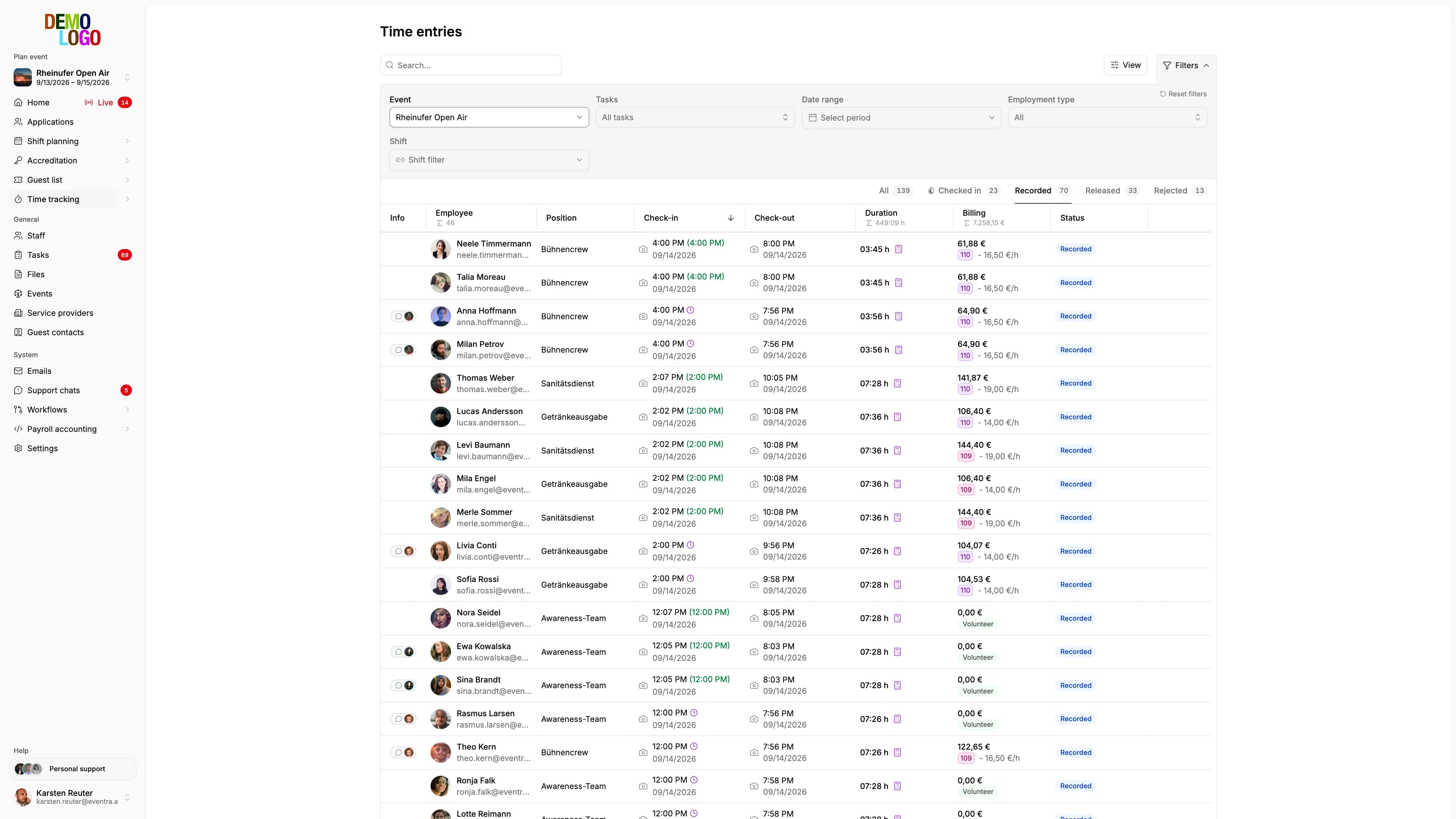
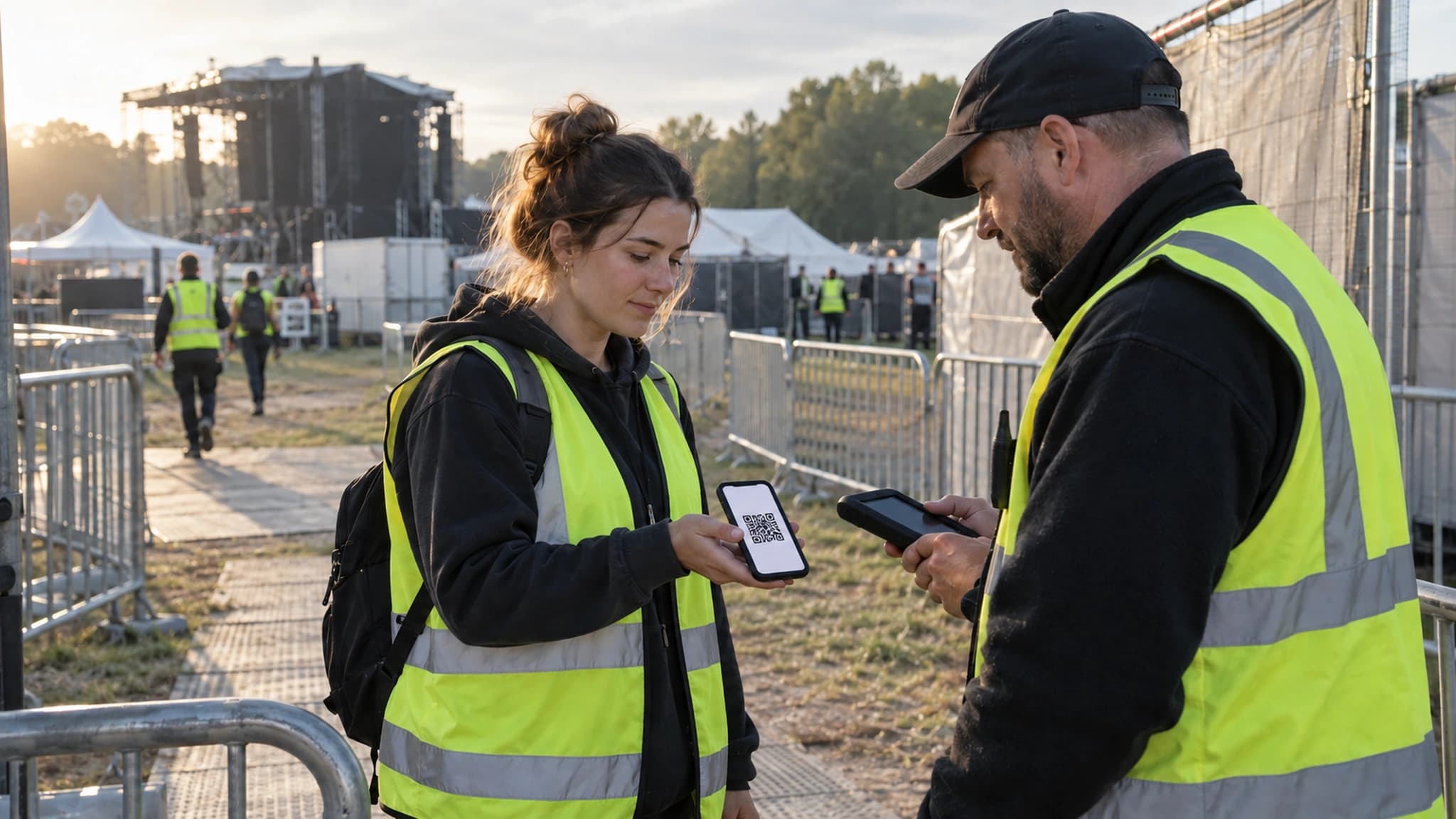
The principle is simple: the person has a QR code in the app or on their badge. At the site, the supervisor scans on arrival and on departure. Every scan produces a timestamp with person, shift, location, and scanner. Three things decide whether this holds up at a festival:
- Offline capability. There's no network at the stage fence. The scan has to be stored locally and synced later, or the line backs up.
- Assignment to the shift. The check-in at 1:52 pm belongs to the 2 to 10 pm shift. Only that assignment turns a timestamp into billable time with premiums.
- Real-time control. Whoever sees at 2:15 pm that three check-ins are missing at the entrance can act. Whoever sees it on Monday has already paid for the gap.
Self-check-in by the person is permitted, as long as the employer controls the recording. In practice, confirmation by the supervisor is the stronger proof, because it ties two people to the timestamp.
What the payroll office needs
Hours, breaks, and premiums arise from the time pairs. For that to work without rework, the rules have to be fixed in advance: from when the night premium applies, how breaks are deducted, how rounding works. Then the month-end close is an export, not retyping. For an audit, the raw data — the timestamps — belongs in the archive for two years, even once payroll is long finished.