Minijob threshold 2026: €603, and what it means for event staff
The marginal-employment threshold (Geringfügigkeitsgrenze) rises to €603 a month in 2026 along with the minimum wage. How it's calculated, when exceeding it is allowed, what a Minijob costs the employer, and why festival months blow the threshold.
En resumen
- The Minijob threshold is €603 a month in 2026, because the minimum wage rises to €13.90. The threshold is tied to the minimum wage: minimum wage times 130, divided by 3, rounded up.
- An unforeseeable excess is allowed in up to two calendar months per year, up to at most double the threshold, i.e. €1,206. A planned festival month is not unforeseeable.
- A Minijob costs the employer roughly 31 percent in flat-rate contributions on top of the wage. For event staff with a few long working days, short-term employment (kurzfristige Beschäftigung) is usually the better-fitting form.
- § 8 Abs. 1 Nr. 1 SGB IV
- § 8 Abs. 1a SGB IV
- § 1 MiLoG in Verbindung mit der Mindestlohnanpassungsverordnung
- § 40a Abs. 2 EStG

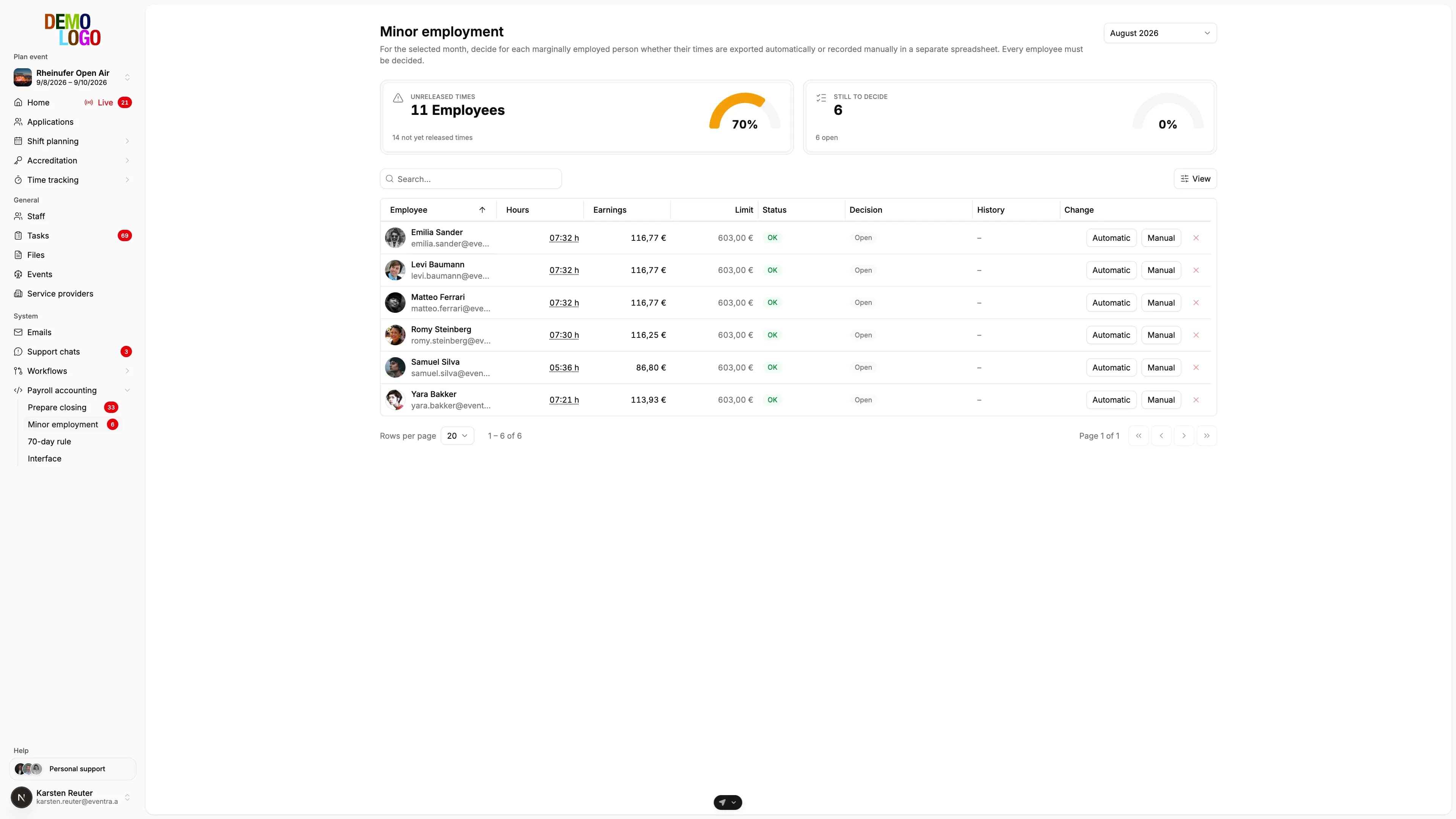
The Minijob threshold sits at €603 a month in 2026. Since October 2022 it has been dynamically tied to the statutory minimum wage and rises with it: from January 1, 2026 the minimum wage is €13.90, and the marginal-employment threshold (Geringfügigkeitsgrenze) results from €13.90 times 130 divided by 3, rounded up to the next full euro. On January 1, 2027 the minimum wage rises to €14.60, and the threshold to €633. For organizers, that means the number changes every year, and the payroll software has to know it.
How the threshold is calculated
The formula in § 8 Abs. 1a SGB IV is built so that a Minijob always allows roughly ten weekly hours at the minimum wage: 10 hours times 13 weeks divided by 3 months is 43.33 hours a month.
| Year | Minimum wage | Minijob threshold per month | Annual earnings limit |
|---|---|---|---|
| 2025 | €12.82 | €556 | €6,672 |
| 2026 | €13.90 | €603 | €7,236 |
| 2027 | €14.60 | €633 | €7,596 |
What matters is the regular monthly earnings averaged over a rolling twelve-month period (Zeitjahr) starting from the beginning of employment. One-off payments such as a Christmas bonus are included proportionally if they can be expected with reasonable certainty.
When exceeding the threshold is allowed
An occasional, unforeseeable excess is harmless if it
- occurs in at most two calendar months within a rolling year, and
- in that month reaches at most double the threshold — €1,206 in 2026.
Covering for illness is unforeseeable. Anything known at the time the contract was signed is foreseeable — for example, the festival in July where the person works four days of twelve hours each. Anyone planning a Minijob worker up to €1,100 in the festival month no longer has a Minijob, but employment subject to social insurance from the month in which that was foreseeable.
What a Minijob costs the employer
The employer pays the Minijob-Zentrale a flat rate, without the employee gaining any benefit entitlement in health or unemployment insurance from it:
- 15 percent pension insurance
- 13 percent health insurance, if the person is covered by statutory health insurance
- 2 percent uniform flat-rate tax, if the employer pays pension insurance at the flat rate
- U1, U2 and insolvency-fund contributions, together under 2 percent
Roughly a 31 percent surcharge on the wage. The employee pays a 3.6 percent own pension-insurance contribution, unless exempted from it. The exemption must be applied for in writing and reported by the employer.
Minijob or short-term employment
For event staff, this is the actual question. Both forms are marginal employment (geringfügige Beschäftigung) under § 8 SGB IV, but they're mutually exclusive with the same employer:
| Minijob | Short-term employment (kurzfristige Beschäftigung) | |
|---|---|---|
| Threshold | €603 a month | 3 months or 70 working days per calendar year |
| Earnings | limited | unlimited |
| Employer contributions | roughly 31% flat rate | none for social insurance, only wage tax or 25% flat tax |
| Typical for | bar crew who come every weekend | festival crew with four days a year |
| Risk | earnings in the festival month | prior employment with other employers |
The employer makes the choice at the start of employment and reports it via the person group (Personengruppe): 109 for the Minijob, 110 for short-term employment. A change within the year is possible but must be reported, and short-term employment is only permitted if the 70 days haven't yet been reached.
Where organizers blow the threshold
- Festival month planned as a Minijob. 12 hours times 4 days times €15 is €720. That's not an unforeseeable excess.
- Premiums forgotten. Night premiums are exempt from contributions up to the tax-free threshold; anything above that counts toward earnings. Anyone paying premiums flat-rate above that threshold blows the limit with the premium itself.
- Second Minijob not asked about. The person works at the municipal hall for €400 and for you for €400. Together €800, both subject to social insurance.
- Last year's threshold still in the software. €556 instead of €603 warns too early; €603 instead of €633 warns too late in 2027.

What that means for planning
The threshold belongs in shift planning, not in the payroll office. Anyone who sees, when assigning a shift, that the person is already at €540 for the month can move the shift to someone else, or clarify before the engagement that the month will become subject to social insurance. After the month-end close, all that's left is the back payment.
See also: Minijob in the documentation glossary.