Rest periods at events: the 11 hours, the exceptions, and the 4 am strike
The Working Hours Act (Arbeitszeitgesetz) requires 11 hours of rest (Ruhezeit) between two shifts. For hospitality and events, exceptions down to 10 hours exist. What applies to build, show day, and strike, where the shift plan breaks, and what about volunteers.
In het kort
- Between the end and the start of work there must be 11 hours of uninterrupted rest (Ruhezeit). In hospitality and certain event operations, it may be shortened to 10 hours if the shortfall is compensated within one month.
- Daily working time is 8 hours, up to 10 hours with compensation within six months. Breaks: 30 minutes from 6 hours, 45 minutes from 9 hours, taken by the latest after 6 hours.
- The typical festival violation isn't the long show day — it's the strike running until 4 am followed by a shift starting at 10 am. That's a shift-planning problem, not a payroll one.
- § 3 ArbZG
- § 4 ArbZG
- § 5 ArbZG
- § 6 ArbZG
- § 10 Abs. 1 Nr. 4 ArbZG
- § 11 Abs. 3 ArbZG
- § 22 ArbZG
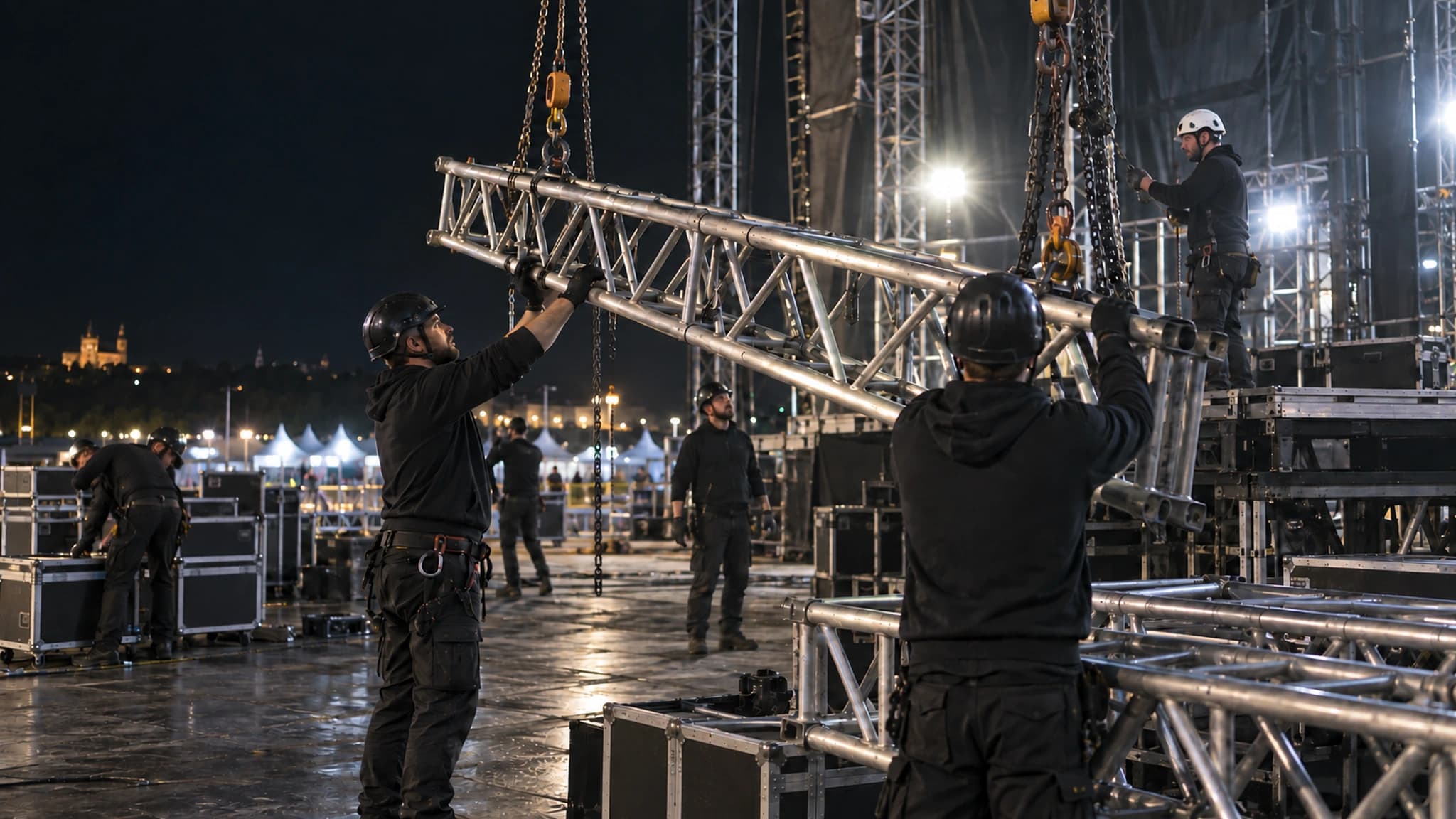
Under § 5 Abs. 1 ArbZG, employees must have an uninterrupted rest period (Ruhezeit) of at least 11 hours after the end of the daily working time. For hospitality, accommodation, transport operations, broadcasting, hospitals, and agriculture, § 5 Abs. 2 ArbZG allows a shortening to 10 hours, if every shortfall is compensated within one calendar month, or within four weeks, by extending another rest period to at least 12 hours. For organizers, the rest period is the rule that breaks most often in the shift plan, because it spans two days that are usually planned separately.
The four limits in the Working Hours Act
| Rule | Limit | Compensation |
|---|---|---|
| Daily working time, § 3 | 8 hours, up to 10 hours | averaging 8 hours over 6 months or 24 weeks |
| Breaks, § 4 | 30 minutes above 6 hours, 45 minutes above 9 hours | by the latest after 6 hours, splittable into segments of 15 minutes |
| Rest period, § 5 | 11 hours; 10 hours in hospitality and event operations | 12 hours within one month |
| Night work, § 6 | 8 hours, up to 10 hours | averaging 8 hours over one month or 4 weeks |
Night time is 11 pm to 6 am. Night-shift workers (Nachtarbeitnehmer) are entitled to occupational health screening and to compensation through time off or a premium, § 6 Abs. 5 ArbZG.
Where the festival plan breaks
A 12-hour show day is usually justifiable if breaks and the half-year compensation add up. The violations happen at the transitions:
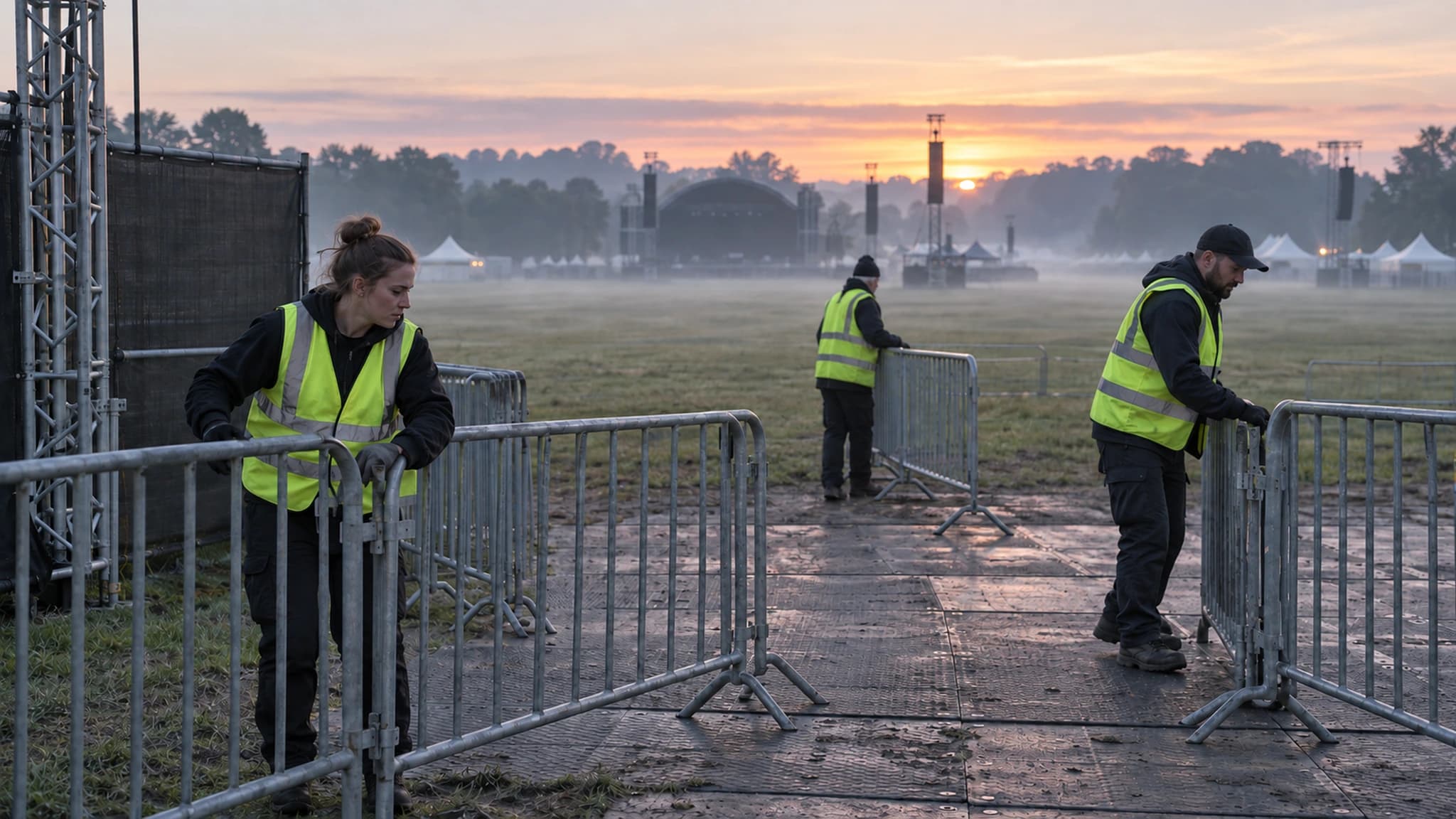
- Strike after the last show. End at 4 am, next shift at 10 am. Six hours of rest. This is the most common case, and the first thing the occupational safety authority (Gewerbeaufsicht) checks.
- Build week. Ten days in a row at 10 hours, with no compensation to 8 hours on average planned anywhere in the half-year.
- Two areas, one person. Bar until 2 am, entrance from 9 am. The bar plan and the entrance plan are two separate tables, and the person is in both.
- Breaks in the tent. 12 hours without a documented 45-minute break. The break has to be fixed in advance, and the person has to be genuinely free to use the time. Standby at the bar is not a break.
- Sunday without a substitute rest day. Sunday work is allowed, but the substitute rest day (Ersatzruhetag) within two weeks gets forgotten.
The exceptions that actually help
- § 5 Abs. 2 ArbZG: 10 instead of 11 hours of rest in hospitality and accommodation, with compensation. Usable for bar crew, and for stage crew only if the operation qualifies as an event operation (Veranstaltungsbetrieb).
- § 14 ArbZG: in exceptional cases that arise independently of the employer's will and whose consequences cannot be remedied any other way, deviation from the limits is allowed. A storm that delays the strike can be such a case. A tight schedule is not.
- § 15 ArbZG: the supervisory authority can, on request, approve further-reaching exceptions, including for the rest period. For a multi-day festival, applying is worthwhile — but it has to be filed before the event.
- Collective agreement (Tarifvertrag), § 7 ArbZG: deviations down to 9 hours of rest are possible under a collective agreement. Not applicable without being bound by one.
Volunteers and freelancers
The Working Hours Act applies to employees. Volunteer helpers aren't covered, and neither are genuinely self-employed freelancers, as long as they're truly independent. Neither is an invitation to ignore the limits: for volunteers, the organizer's accident insurance is engaged, and a helper who has an accident with a forklift after 16 hours is a liability case. For freelancers who appear in the shift plan and receive instructions, genuine independence is the real question.
Documentation
§ 16 Abs. 2 ArbZG obliges the employer to record working time exceeding 8 hours and to retain it for two years. For Minijob workers and in the industries covered by the undeclared-work law (Schwarzarbeitsbekämpfungsgesetz), § 17 MiLoG requires start, end, and duration of daily working time, recorded by the latest on the seventh day after. Since the Federal Labor Court's (Bundesarbeitsgericht) ruling of September 13, 2022, there is in any case a general obligation to record the entire working time. A shift plan is not proof; a check-in time with a check-out is.
What that means for planning
The rest period is a rule spanning two shifts, so the tool that assigns shifts has to check it. When assigning the early shift, the same person's night shift has to be visible, regardless of which area it was in. Breaks belong in time tracking as a rule, and the substitute rest day belongs in the plan for the next two weeks as a blocked day.

See also: ArbZG in the documentation glossary.