AI shift planning for events: what the model proposes, what rules check and what a person decides
What AI shift planning really delivers at festivals and events: rules filter qualification, availability, rest periods, Minijob and the 70-day limit, the model proposes an assignment with a reason, the planner books. With a checklist for choosing an AI shift planner.
In het kort
- AI shift planning means three things in practice that have to stay separate: rules that check every shift deterministically, a model that proposes an assignment with a reason from the checked candidates, and a person who books.
- Whatever can be decided without a model does not belong in the model: qualification, availability, 11 hours of rest, the Minijob limit and the 70-day limit are rules. The model only gets what is left afterwards.
- An AI shift planner is usable when every proposal names its reason, nothing is booked without a click, the data stays in the EU and is not used for training.
- § 5 ArbZG
- § 8 SGB IV
- Art. 22 GDPR
- Art. 28 GDPR
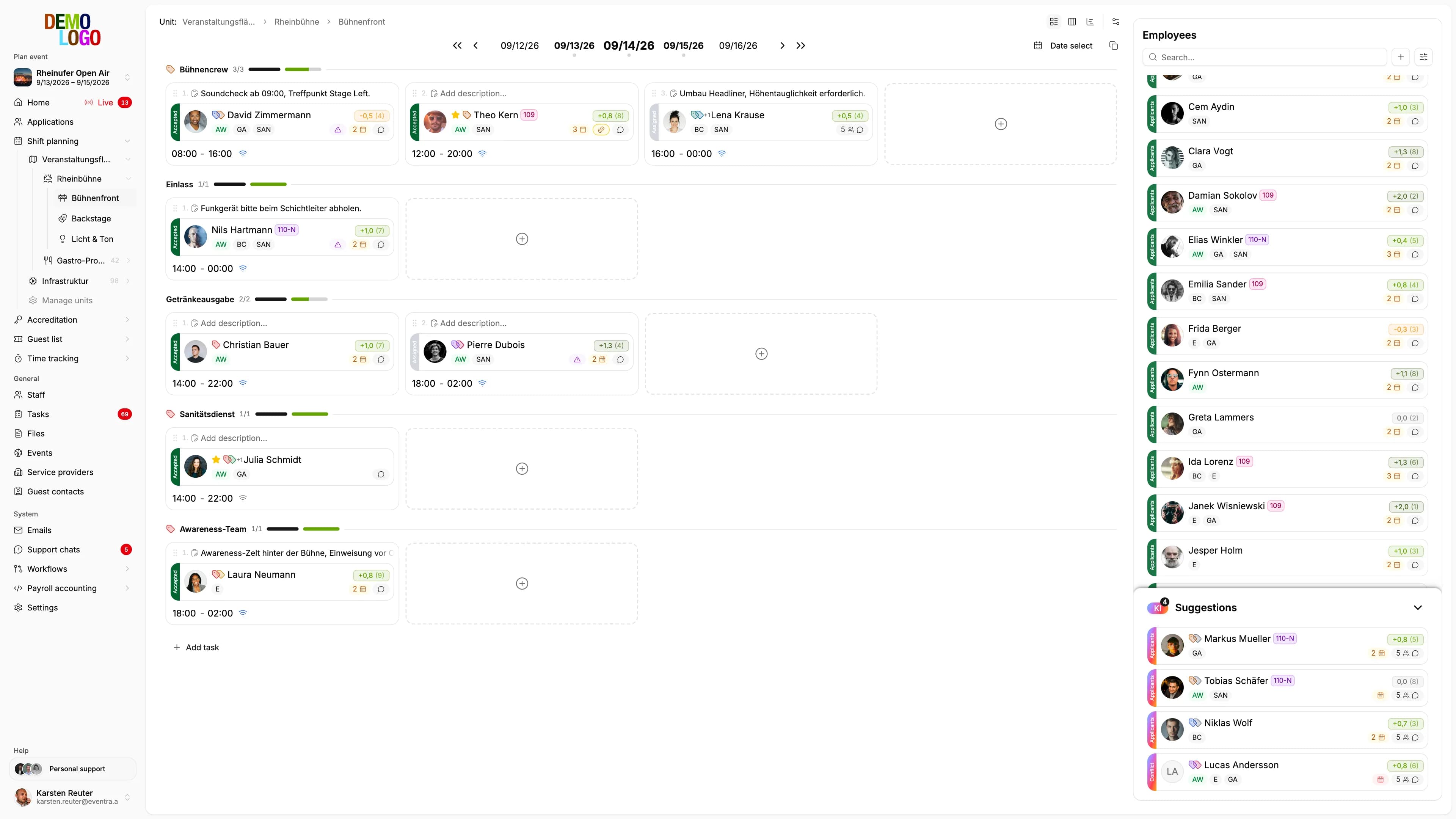
AI shift planning at events is filling open shifts with a proposal from a language model after rules have filtered the candidates by qualification, availability, rest period and statutory limits. The model names a person, the reason and a confidence; the planner books. What vendor brochures call "AI plans your shifts" is three different things, and whether a tool is any good depends on whether it keeps them apart.
Three layers that have to stay separate
| Layer | What it does | Example | Who decides |
|---|---|---|---|
| Rules | Check every shift deterministically, same result for the same input | Rest period 11 hours, Minijob limit, 70 days, qualification, availability | Nobody; the result is fixed |
| Model | Weighs the rest that rules cannot decide and proposes | "M. Keller: bar licence, free on Saturday, 41 of 70 days, confidence 92 %" | The model proposes |
| Person | Accepts or discards, books, approves | Accept the card, the shift is filled | The planner |
A tool that mixes the three layers has two typical failures. It lets the model calculate what a formula does better and then produces rest-period violations with 90 percent confidence. Or it books without a click, and nobody can say later why the person was in that shift.
What is checked before the model
Five checks have an unambiguous answer and therefore belong in rules, not in a model:
- Qualification. The shift requires a bar licence, a forklift licence or first-aid training; the person has it or not. That is a tag on the profile.
- Availability. The person named the day in the application or not.
- Rest period. Between the end of the same person's last shift and the start of the next there must be 11 hours, § 5 ArbZG, 10 in event operations with compensation. That is a subtraction. What applies to build, show day and strike is in Rest periods at events.
- Minijob limit. The planned pay of the month against 603 euros. A multiplication and a comparison.
- 70-day limit. Worked plus planned days of the calendar year against 70, § 8 (1) no. 2 SGB IV. A count across all events, see Short-term employment.
Out of 200 people in the pool, perhaps twelve remain for a Saturday bar shift after these five checks. Only now is a model worth it.
What the model adds
Twelve candidates who are all allowed: who fits best? Here a language model helps, because the criteria are soft. Who wrote "preferably in a team with Lisa" in the application? Who did the same bar last year? Who has used 41 of 70 days and who 68? Who already has four night shifts in a row? The model reads these signals and proposes one person, with two sentences of reasoning and a confidence. The reasoning is the actual value: it makes the proposal checkable. A proposal without a reason is a die with a user interface.
Two further tasks suit a model because they read across a whole list instead of filling one shift:
- Same person, three spellings. In the applicant list and across the lists of all contractors in accreditation, the model recognises typos, double names and swapped fields and flags what belongs together. Merging is a click.
- Check of the monthly close. Rules calculate markers per time entry: night work, missing break, overlap, deviation of start and duration from the plan. The model reads which combinations are payroll-relevant and would rather name three solid findings than twelve weak ones. Every finding shows its evidence.
What a person decides, and why that is not a formality
A shift booking has legal consequences: it creates working time, pay and social-insurance contributions. Art. 22 GDPR gives every person the right not to be subject to a decision based solely on automated processing that produces legal effects. A shift planner that books without confirmation moves into that territory. A shift planner that proposes and waits for the click does not. The difference is not the technology but the click, and it has to be deliberate: an "accept all proposals" button is the same automation with a detour.
The same applies to the month-close check. The model names findings; approving the hours stays with HR. And for the look-alikes: the model flags the pair, whether it is one person is decided by someone who knows them.
Data protection: what the model sees and where it runs
| Question | The answer you should hear |
|---|---|
| Where does the model run? | In the EU, with the region named. A US endpoint is a transfer to a third country. |
| Are inputs used for training? | No, contractually guaranteed. For models via a cloud provider, that is in the provider's terms. |
| Does the model see real names? | For assignment proposals yes, otherwise the proposal cannot be checked. For the month-close check no: people reach the model as references. |
| Is there a data processing agreement? | Yes, Art. 28 GDPR, with the model provider as sub-processor. |
| Can I switch the AI off? | Yes, per function, without the shift plan ceasing to work. |
The last row is the test. A shift planner that no longer plans without the model has moved the rules into the model.
Checklist: choosing an AI shift planner
| Criterion | How to recognise it |
|---|---|
| Rules before the model | Rest period, Minijob, 70 days are flagged in the plan without AI too |
| Reason per proposal | Two sentences and a confidence, not a list without a reason |
| No booking without a click | Proposal as a card, accepting is an action |
| EU region and no training | Named in the privacy policy and the data processing agreement |
| Pseudonymisation where possible | Month-close check without real names |
| Switchable per function | A switch in the settings, not a support ticket |
| Price without an AI module | Included in the platform fee or transparent per call |
| Finding nothing is a result | The model would rather report nothing than weak findings |
Whoever ticks these eight points does not get a tool that makes the shift plan. They get one that replaces the look across 200 names and flags the error before the person stands at the gate. That is the part of shift planning that used to happen at night.