Short-term employment 2026: the 70-day rule for event staff
When festival casual staff stay exempt from social insurance, how the 70 days and 3 months are counted, what 'occupational' (berufsmäßig) means, and where organizers blow the limit.
En resumen
- Short-term employment (kurzfristige Beschäftigung) is work that lasts at most 3 months or 70 working days within a calendar year and is not done on an occupational (berufsmäßig) basis. In that case, no social-insurance contributions apply.
- All short-term engagements within the calendar year are added together, including with other employers. The employer must ask about prior employment at hiring and document the answer.
- The limit is most often blown by crew who work for several organizers over the summer. Whoever doesn't ask about prior employment is liable for the contributions.
- § 8 Abs. 1 Nr. 2 SGB IV
- § 8 Abs. 2 SGB IV
- § 40a Abs. 1 EStG
- Geringfügigkeits-Richtlinien der Spitzenorganisationen der Sozialversicherung
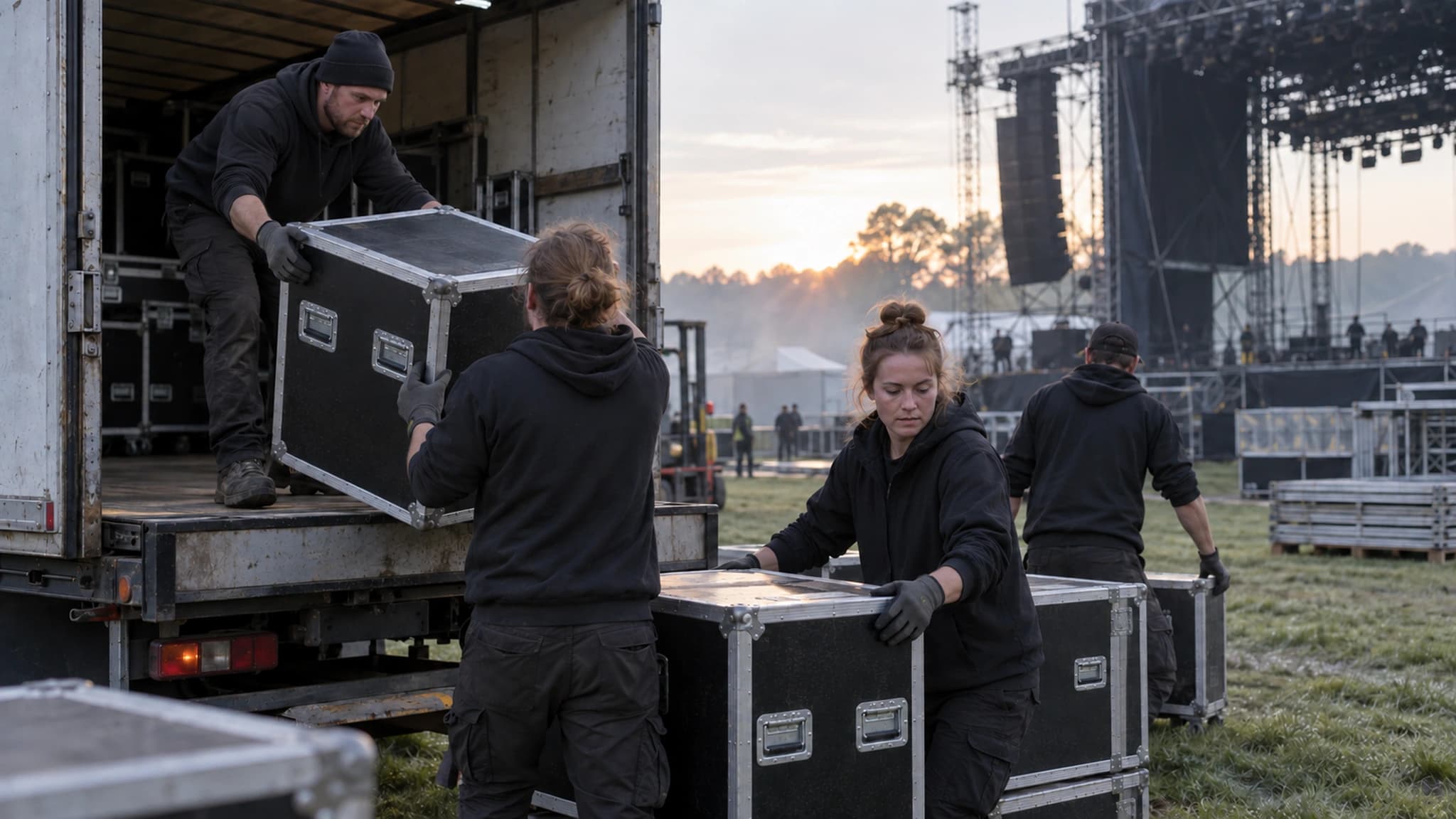
Under § 8 Abs. 1 Nr. 2 SGB IV, short-term employment (kurzfristige Beschäftigung) is employment limited within a calendar year to at most three months or 70 working days, and not carried out on an occupational (berufsmäßig) basis. It is exempt from contributions across all branches of social insurance. For organizers, this is the employment form for most of the festival crew: students, retirees, people with a main job elsewhere, who help out for a few days over the summer. The limit isn't counted per event, but per person and per calendar year, across all employers.
Who is allowed to be short-term employed
Three conditions must all be met at once:
- Time limit: at most 3 months or 70 working days in the calendar year. The limit has to be agreed from the outset, in the contract or by the nature of the engagement — for example, a festival from September 8 to 10.
- No occupational character (Berufsmäßigkeit): the employment must not be of significant economic importance for the person. Students, pupils, retirees, homemakers, and people with a main job are unproblematic. Problematic are unemployed people, people between school and vocational training with no other coverage, and anyone who earns their living predominantly from such jobs.
- No aggregation over the limit: all short-term engagements for the year are added up. 40 days at the spring festival, 20 days at the open-air, and 15 days at the trade fair make 75 days. The last engagement becomes subject to social insurance.
The amount earned doesn't matter for social insurance purposes. A short-term engagement is allowed to bring in more than the Minijob threshold.
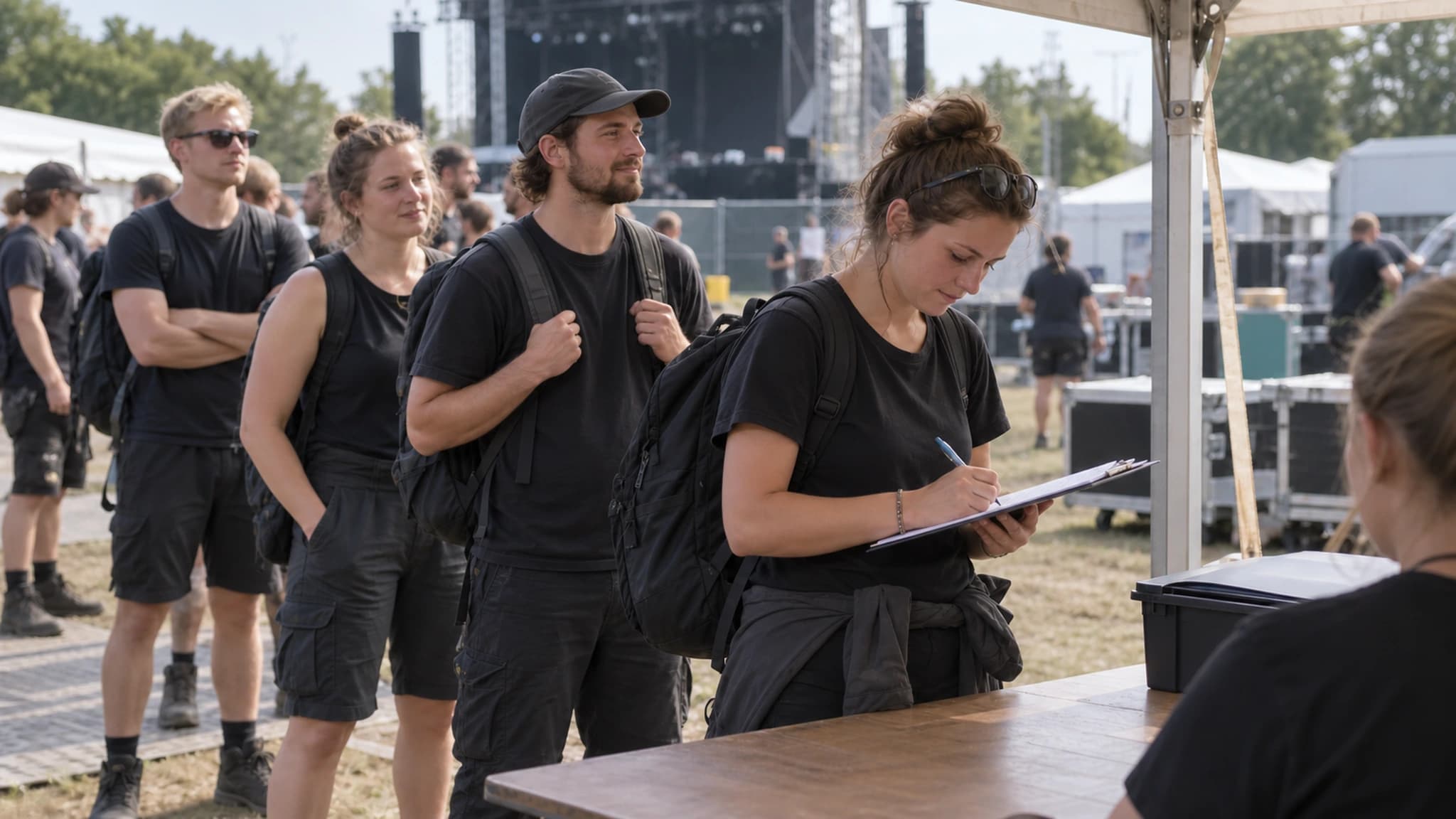
70 working days or 3 months
The umbrella social-insurance bodies set out in the Geringfügigkeits-Richtlinien (marginal-employment guidelines) which threshold applies:
| Employment | Standard |
|---|---|
| At least 5 days a week | 3 months (calendar months or 90 calendar days) |
| Fewer than 5 days a week | 70 working days |
Event crew almost always work on individual days or weekends, so the 70-working-day threshold applies. Every calendar day with work performed is counted. A build day from 6 am to 10 pm is one day. A night shift from 8 pm to 4 am is, under prevailing practice, also one day, as long as it's a single continuous shift.
How it's counted
The employer must check, at the start of the engagement, whether the limit will be met within the current calendar year. That includes asking about prior employment. In practice:
- At hiring, the person signs a declaration of prior employment (Erklärung über Vorbeschäftigungen) for the current calendar year: employer, period, number of working days.
- The employer adds its own planned days to that. If the total exceeds 70, the employment is subject to social insurance from the start.
- During the engagement, the employer keeps counting. As soon as it becomes foreseeable that the limit will be exceeded, liability for contributions starts from that day, not retroactively.
- If the query is missing or wrong, the employer bears the risk. Deutsche Rentenversicherung specifically checks these declarations during an employer audit (Betriebsprüfung).
For organizers with several events a year, counting their own days is the smaller problem. The bigger one is crew who, in the same summer, also work for the neighboring festival, the municipal hall, and a staffing agency. Only asking reveals those days.
Tax: flat 25 percent or individual wage-tax deduction
For tax purposes, short-term employment is a normal employment relationship. Two paths:
- Individual wage tax based on the person's electronic wage-tax deduction data. For students with tax bracket I, typical festival earnings usually attract little or no wage tax.
- Flat-rate taxation at 25 percent (Pauschalierung) under § 40a Abs. 1 EStG, if the engagement doesn't exceed 18 consecutive working days, the average wage doesn't exceed €150 per working day, or the engagement becomes necessary at short notice at an unforeseeable time — and the hourly wage is at most €19. The employer bears the flat tax, plus the solidarity surcharge and, where applicable, church tax.
The 18-day threshold for flat-rate taxation is a tax-law limit and has nothing to do with the 70 days of social insurance. Both are checked separately.
Where organizers blow the limit
From practice, in this order:
- No query on prior employment. The form is missing or not evaluated. At audit time, there's no proof, and the organizer pays the contributions retroactively.
- Build and strike not counted. Anyone doing three weeks of build, four festival days, and a week of strike is at 30 days before the season really starts.
- The same person at two entities. An event GmbH and a hospitality GmbH within the same group are two employers, but the days are still added together.
- Overlooking occupational character (Berufsmäßigkeit). A person who moves from festival to festival from May to September, with nothing else going on, is occupationally employed, no matter how many days that adds up to.
- Multi-year framework contracts. A framework contract providing for repeated engagements over more than one year can call the short-term nature into question overall. Better: one fixed-term contract per event.
What that means for planning
The 70 days are a planning figure, not a payroll figure. Anyone who only counts them at month-end close ends up in September with people at 68 days who still have three shifts on the plan. Counting has to happen in shift planning, with the days from the self-declaration as the starting value, tracked time as the actual, and booked shifts as the forecast. Then the decision on whether the person continues as a Minijob or as subject to social insurance from October falls before the shift, together with the person.
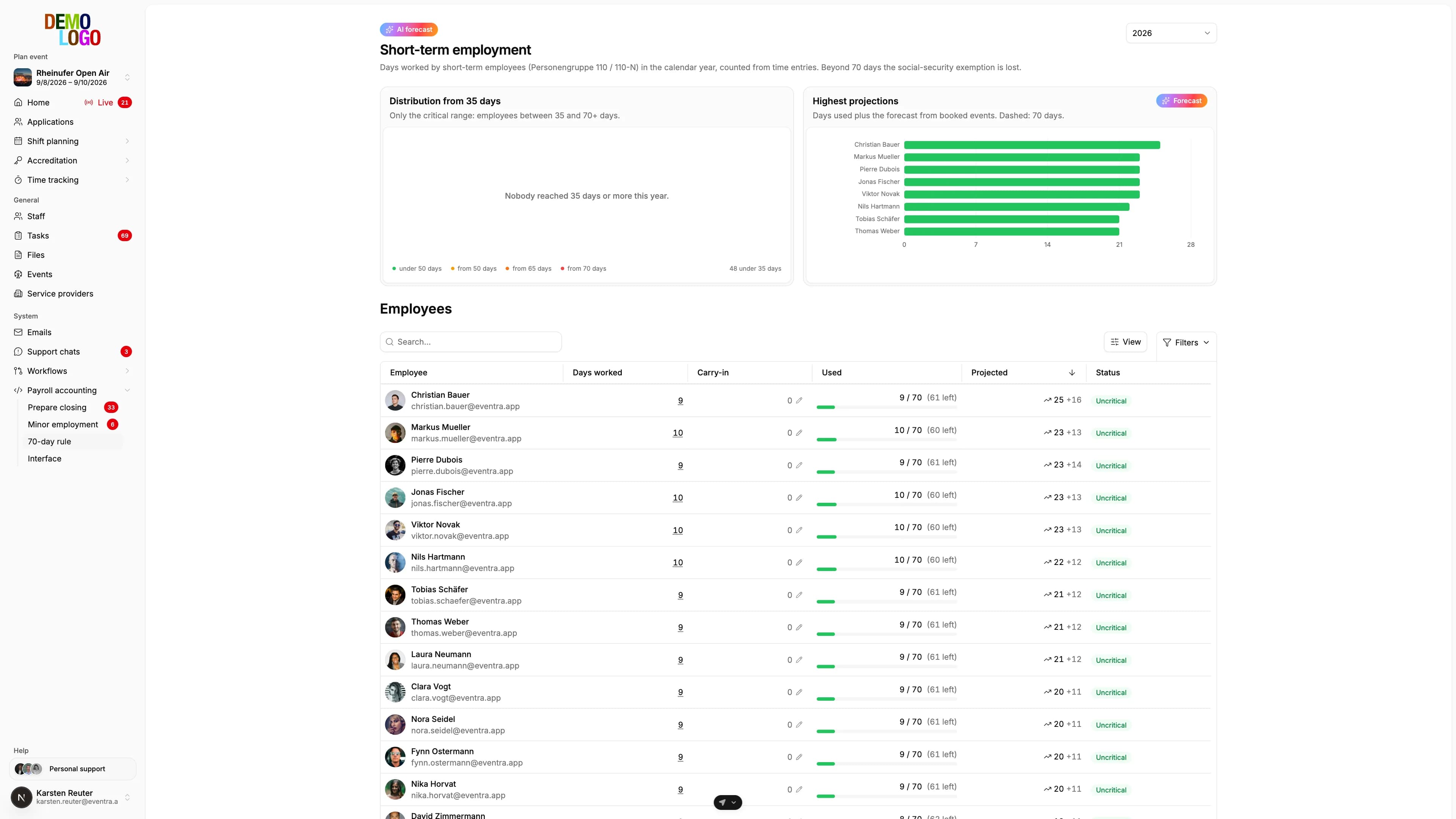
See also: 70-day rule in the documentation glossary.